

Is your environmental claim self declared and not monitored by an independent third party?
Does your company publish an environmental claim? Is that claim about future environmental performance? Is your environmental claim self‑declared and not monitored by an independent third party?
Then the EmpCo‑directive and its transposition into member state legislation is highly relevant to you.
1. What is EmpCo?
EmpCo refers to Directive (EU) 2024/825 of the European Parliament and of the Council of 28 February 2024. This directive amends Directives 2005/29/EC and 2011/83/EU with the objective of empowering consumers for the green transition through strengthened protection against unfair practices and improved access to reliable information.
The directive aims to reduce misleading environmental claims, increase transparency, and ensure that consumers receive accurate, verifiable, and comparable information. It introduces specific rules concerning the substantiation of environmental statements, the use of sustainability labels, and the communication of environmental performance, including future performance.
EmpCo requires that environmental claims be supported by robust evidence, communicated clearly, and verified when necessary. Claims concerning future environmental improvements must be backed by realistic plans, measurable objectives, and independent monitoring. Overall, EmpCo establishes a more rigorous regulatory environment to prevent greenwashing and increase consumer trust.
2. For which claims and labels does Empco apply?
EmpCo applies to all business to consumer green claims, regardless of form, scope, or communication medium. Any statement suggesting an environmental benefit, improvement, or reduced impact falls under its requirements.
But this does not mean that claims which are considered business to business should not be “tested” against the Empco-directive.
The directive also prohibits certain types of environmental claims:
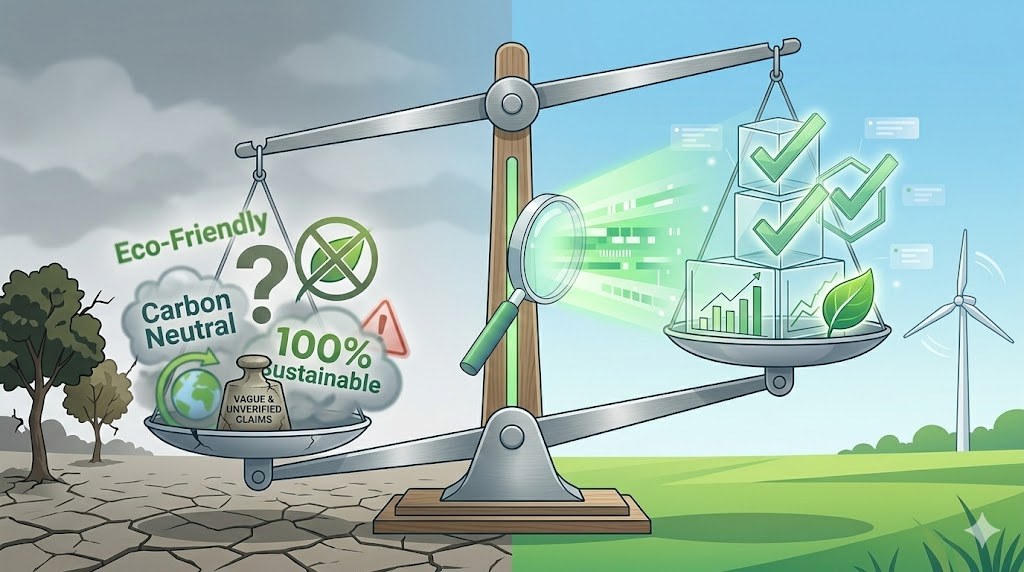
• Generic environmental claims are prohibited unless recognised excellent environmental performance can be demonstrated. Examples include environmentally friendly, eco‑friendly, green, nature’s friend, ecological, environmentally correct, climate friendly, gentle on the environment, carbon friendly, energy efficient, biodegradable, biobased, or similar statements. These claims are not allowed if the trader cannot prove excellent environmental performance relevant to the claim.
• Claims based on greenhouse gas offsetting are restricted. It is prohibited to state or imply that a product has a neutral, reduced, or positive environmental impact based on purchased offsets rather than actual emission reductions within the product lifecycle or value chain. Claims such as carbon neutral or CO2 compensated are therefore limited unless they reflect real reductions, not external compensation.
• Sustainability labels are restricted. A sustainability label may only be used if it is based on a certification scheme or established by a public authority.
• Claims about future environmental performance must meet strict criteria. A claim referring to future improvements—such as CO2 emission reduction targets, commitments to future use of 100 percent renewable electricity, or expected future reductions in environmental impact—may only be made if supported by a detailed, realistic, and verifiable implementation plan. Without such evidence, future-oriented claims are prohibited. These claims must be periodically monitored by an independent third party.
3. When will EmpCo be implemented in member states? How will EmpCo be implemented?
Member states must transpose the directive into national law by 27 March 2026. It will become enforceable from 27 September 2026.
Implementation will follow the principle of maximum harmonisation. This means that national legislators cannot deviate from the provisions of the directive. There are no optional clauses or national flexibility mechanisms. As a result, the national laws will reproduce the directive’s provisions faithfully, ensuring consistent application across all EU member states.
4. What should you do when you have a green claim?
If your organisation communicates any business to consumer green claim, you must verify that the claim fully complies with EmpCo. This includes ensuring that the claim is specific, accurate, substantiated with recognised methods, and presented transparently. Unsupported generic statements must be avoided.
5. What should you do when your green claim is about a future environmental performance?
Claims concerning future environmental performance must be supported by clear, objective, and publicly available commitments. These commitments must be embedded in a detailed and realistic implementation plan describing measurable and time‑bound targets, resource allocation, and all relevant actions required for implementation.
The plan must be regularly monitored by an independent third‑party expert. Verification outcomes must be made accessible to consumers. Without these elements, future environmental performance claims cannot be made under EmpCo.
6. My company only has a Business‑to‑Business claim so is this claim not impacted by the Empco‑directive?
Even if your company’s claim is Business‑to‑Business, it can still be impacted by the Empco‑directive. This is particularly the case when a B2B claim can be interpreted as, or effectively operates as, a claim that flows through to the end‑consumer.
Furthermore, corporate communications—such as those found on corporate websites—often blend messages intended for business partners, consumers, and even employees. Because both consumer‑directed (B2C) and employee‑directed (B2E) communications fall within the scope of the EmpCo‑directive, corporate websites frequently end up being covered as well. Although each situation requires an individual assessment, in practice corporate websites often reach or influence consumers, even if unintentionally. When a company also maintains a consumer‑facing website that refers back to the corporate site for information on sustainability or ESG initiatives, the corporate content is almost certainly in scope. But even without such cross‑linking, many corporate websites still speak to the general public and are designed to build and promote the company’s brand—making them likely to fall under EmpCo.
If your client provides services to consumers and your client’s consumer‑facing claim is based on, derived from, or passed through your B2B claim, then your claim may need to be made compliant with the Empco‑directive. Your customer may inform you that they intend to rely on your B2B claim as part of their consumer‑facing communications, in which case you may need to adjust the wording or substantiation to ensure it meets the Empco requirements. Therefore, a B2B claim is not automatically outside the scope—its impact on consumer claims determines whether the directive is relevant for you
7. How can Vinçotte help?
- Assess if your claim is in line with Empco
- Identify any gaps to achieve compliance
- Verify/validate the claim
- Perform the mandatory monitoring when the claim concerns future environmental performance